Clarify the real question
Clarify the real leadership question behind the AI question, including what is at stake and what leaders are actually accountable for.
The AIchemy method
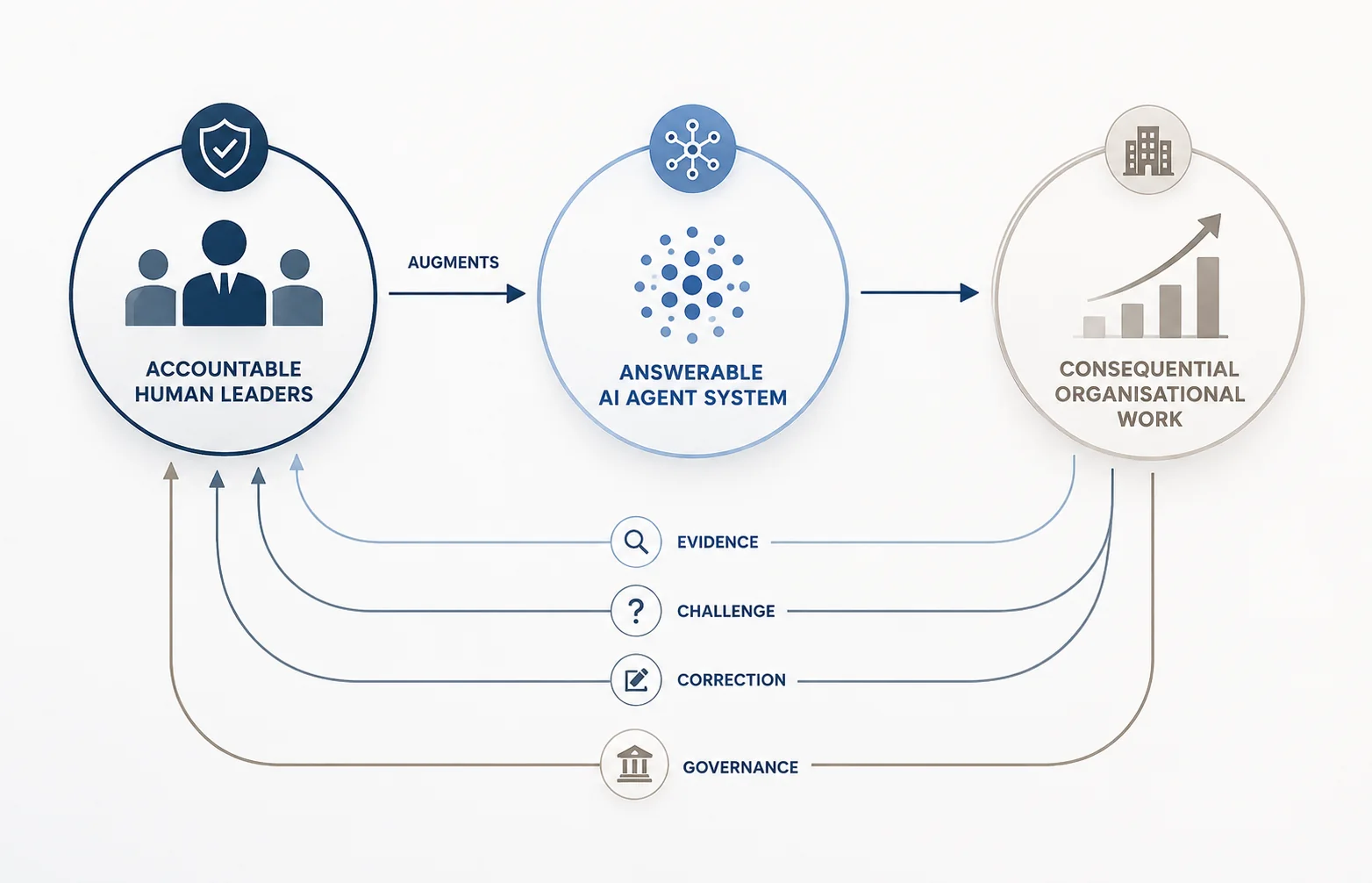
AIchemy helps leadership teams use AI agents as disciplined thinking partners without handing over the framing, context, or accountability behind consequential decisions.
The method creates a structured space where assumptions can be challenged, competing perspectives can be held, AI-generated possibilities can be tested, and leaders can return to action with clearer human ownership.
Why ordinary AI use is not enough
Most AI use collapses the interaction into a quick exchange: ask a question, receive an answer, decide whether to use it.
When AI agents enter the work, the stakes rise: AI may pursue tasks, use tools, remember context, coordinate activity, and shape work over time.
AIchemy slows the interaction down. It makes the human-AI relationship structured, inspectable, and answerable.
What the method makes possible
Clarify the real leadership question behind the AI question, including what is at stake and what leaders are actually accountable for.
Notice where AI is influencing framing, evidence, memory, workflow, momentum, and confidence before those influences become hard to challenge.
Bring assumptions, tensions, competing perspectives, hidden risks, and partial truths into the open.
Use AI agents to generate perspectives, challenge assumptions, test options, and improve judgment without substituting AI output for human responsibility.
Set boundaries, escalation points, evaluability principles, and what must remain unmistakably human-owned.
Leave with a clearer executive point of view, practical next steps, and decisions leaders are prepared to own.
AI as catalyst, mirror, and challenger
Inside the AIchemy process, AI can act as catalyst, mirror, challenger, perspective-generator, pattern-finder, language partner, and memory-holder.
But AI does not become the authority. Human judgment remains responsible for context, values, consequences, trade-offs, and action.
That is why the method is not a prompt sequence. It creates enough structure for leaders to work with AI agents seriously while keeping judgment, authorship, and accountability human.
AI-supported work becomes more trustworthy when leaders can see what is being framed, assumed, omitted, amplified, and carried forward.
AIchemy gives teams a way to question the AI's framing, correct its assumptions, reject false coherence, bring in lived context, and decide what they are prepared to own.
How judgment remains answerable
What makes it different
Workshop